
The well-known first picture of a black gap just got two times sharper. A analysis group used synthetic intelligence to dramatically enhance upon its first image from 2019, which now exhibits the black gap on the heart of the M87 galaxy as darker and larger than the primary picture depicted.
I’m an astronomer who research and has written about cosmology, black holes and exoplanets. Astronomers have been utilizing AI for many years. In actual fact, in 1990, astronomers from the College of Arizona, the place I’m a professor, have been among the many first to use a type of AI called a neural network to review the shapes of galaxies.
Since then, AI has unfold into each subject of astronomy. Because the know-how has turn into extra highly effective, AI algorithms have begun serving to astronomers tame large knowledge units and uncover new information in regards to the universe.
Higher telescopes, extra knowledge
So long as astronomy has been a science, it has concerned making an attempt to make sense of the multitude of objects within the evening sky. That was comparatively easy when the one instruments have been the bare eye or a easy telescope, and all that may very well be seen have been just a few thousand stars and a handful of planets.
100 years in the past, Edwin Hubble used newly constructed telescopes to point out that the universe is full of not simply stars and clouds of fuel, but countless galaxies. As telescopes have continued to enhance, the sheer variety of celestial objects people can see and the amount of data astronomers have to kind by way of have each grown exponentially, too.
For instance, the soon-to-be-completed Vera Rubin Observatory in Chile will make photos so giant that it will take 1,500 high-definition TV screens to view each in its entirety. Over 10 years it’s anticipated to generate 0.5 exabytes of information – about 50,000 occasions the quantity of knowledge held in all the books contained inside the Library of Congress.
There are 20 telescopes with mirrors bigger than 20 toes (6 meters) in diameter. AI algorithms are the one method astronomers might ever hope to work by way of all the knowledge accessible to them immediately. There are a variety of how AI is proving helpful in processing this knowledge.
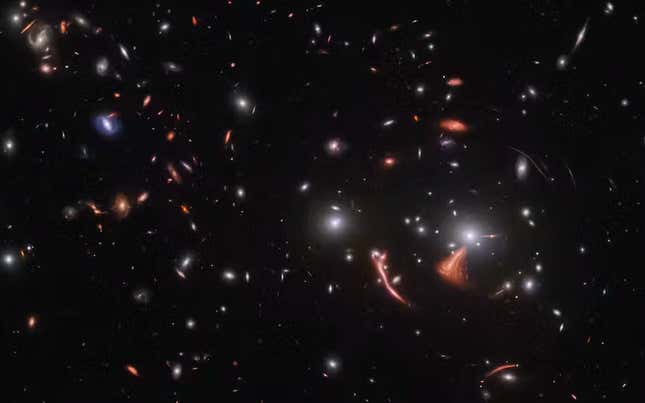
One of many earliest makes use of of AI in astronomy was to pick the multitude of faint galaxies hidden within the background of photos.
ESA/Webb, NASA & CSA, J. Rigby, CC BY
Choosing out patterns
Astronomy usually includes in search of needles in a haystack. About 99% of the pixels in an astronomical picture comprise background radiation, gentle from different sources or the blackness of area – only one% have the delicate shapes of faint galaxies.
AI algorithms – specifically, neural networks that use many interconnected nodes and are in a position to study to acknowledge patterns – are completely suited to choosing out the patterns of galaxies. Astronomers started using neural networks to classify galaxies within the early 2010s. Now the algorithms are so effective that they will classify galaxies with an accuracy of 98%.
This story has been repeated in different areas of astronomy. Astronomers engaged on SETI, the Seek for Extraterrestrial Intelligence, use radio telescopes to search for indicators from distant civilizations. Early on, radio astronomers scanned charts by eye to look for anomalies that couldn’t be defined. Extra lately, researchers harnessed 150,000 private computer systems and 1.8 million citizen scientists to search for synthetic radio signals. Now, researchers are utilizing AI to sift by way of reams of information far more shortly and totally than individuals can. This has allowed SETI efforts to cowl extra floor whereas additionally tremendously decreasing the number of false positive signals.
One other instance is the seek for exoplanets. Astronomers found many of the 5,300 known exoplanets by measuring a dip within the quantity of sunshine coming from a star when a planet passes in front of it. AI instruments can now pick the indicators of an exoplanet with 96% accuracy.
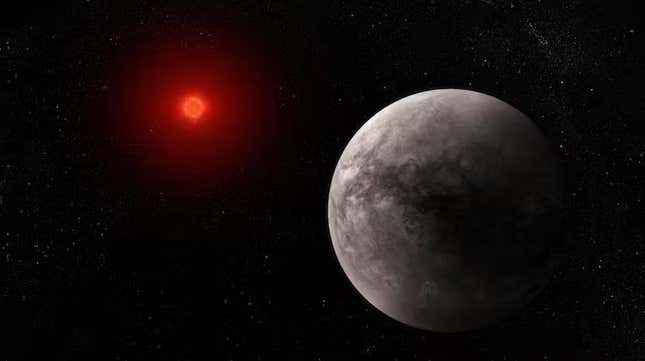
AI instruments may help astronomers uncover new exoplanets like TRAPPIST-1 b.
NASA, ESA, CSA, Joseph Olmsted (STScI), CC BY
Making new discoveries
AI has proved itself to be glorious at figuring out identified objects – like galaxies or exoplanets – that astronomers inform it to search for. However it is usually fairly highly effective at discovering objects or phenomena which might be theorized however haven’t but been found in the actual world.
Groups have used this strategy to detect new exoplanets, study in regards to the ancestral stars that led to the formation and progress of the Milky Method, and predict the signatures of recent forms of gravitational waves.
To do that, astronomers first use AI to transform theoretical fashions into observational signatures – together with reasonable ranges of noise. They then use machine studying to sharpen the flexibility of AI to detect the expected phenomena.
Lastly, radio astronomers have additionally been utilizing AI algorithms to sift by way of indicators that don’t correspond to identified phenomena. Not too long ago a group from South Africa discovered a unique object which may be a remnant of the explosive merging of two supermassive black holes. If this proves to be true, the info will permit a brand new check of basic relativity – Albert Einstein’s description of space-time.
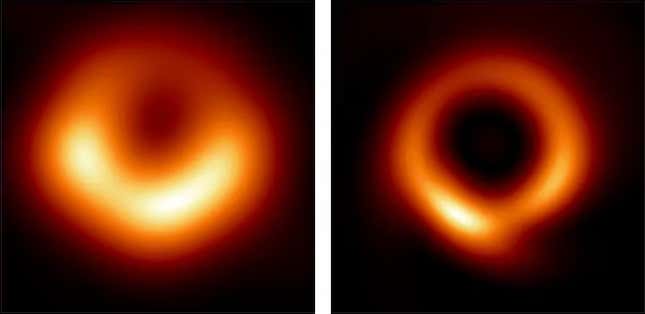
The group that first imaged a black gap, at left, used AI to generate a sharper model of the picture, at proper, exhibiting the black gap to be bigger than initially thought.
Making predictions and plugging holes
As in lots of areas of life lately, generative AI and huge language fashions like ChatGPT are additionally making waves within the astronomy world.
The group that created the primary picture of a black gap in 2019 used a generative AI to produce its new image. To take action, it first taught an AI the way to acknowledge black holes by feeding it simulations of many sorts of black holes. Then, the group used the AI mannequin it had constructed to fill in gaps within the large quantity of information collected by the radio telescopes on the black gap M87.
Utilizing this simulated knowledge, the group was in a position to create a brand new picture that’s two occasions sharper than the unique and is totally according to the predictions of basic relativity.
Astronomers are additionally turning to AI to assist tame the complexity of contemporary analysis. A group from the Harvard-Smithsonian Middle for Astrophysics created a language model called astroBERT to learn and manage 15 million scientific papers on astronomy. One other group, based mostly at NASA, has even proposed utilizing AI to prioritize astronomy projects, a course of that astronomers interact in each 10 years.
As AI has progressed, it has turn into a necessary device for astronomers. As telescopes get higher, as knowledge units get bigger and as AIs proceed to enhance, it’s doubtless that this know-how will play a central position in future discoveries in regards to the universe.
Wish to know extra about AI, chatbots, and the way forward for machine studying? Take a look at our full protection of artificial intelligence, or browse our guides to The Best Free AI Art Generators and Everything We Know About OpenAI’s ChatGPT.
Chris Impey, College Distinguished Professor of Astronomy, University of Arizona
This text is republished from The Conversation below a Inventive Commons license. Learn the original article.
Trending Merchandise

Sceptre Curved 32-inch FHD 1080p Ga...

HYTE Y60 Modern Aesthetic Dual Cham...

Dell Pro KM5221W Keyboard & Mou...

LG 22MK430H-B 21.5-Inch Full HD Mon...

Razer Turret Wireless Mechanical Ga...

AOPEN 20CH1Q bi 19.5″ HD (136...

HP Newest 14″ HD Laptop, Wind...

Lenovo 510 Wireless Keyboard & ...

Logitech G910 Orion Spectrum RGB Wi...
